
Examination and diagnosis
We examine each tooth and, where needed, x-ray it to find the decay hiding between teeth or underneath old fillings.

Treating decay and repairing damaged teeth with tooth-coloured fillings — the simplest way there is to keep your own tooth in place.
This is where most dental care plans begin: we stop the decay spreading and rebuild the tooth before the infection reaches the nerve.
Decay happens when bacteria in plaque turn sugars into acids that demineralise the enamel. At the start it neither hurts nor shows — which is why so many cavities are found at a check-up or on an x-ray. Caught early, a cavity is settled in one appointment with a simple filling.
We use composite materials the colour of your teeth, matched to their shade. Alongside ordinary fillings, we rebuild heavily damaged teeth with composite build-ups that restore both the shape and the natural look of the tooth.
Where decay has already reached the nerve, a filling is no longer enough: a root canal is needed first, and the tooth is rebuilt afterwards.
See root canal treatment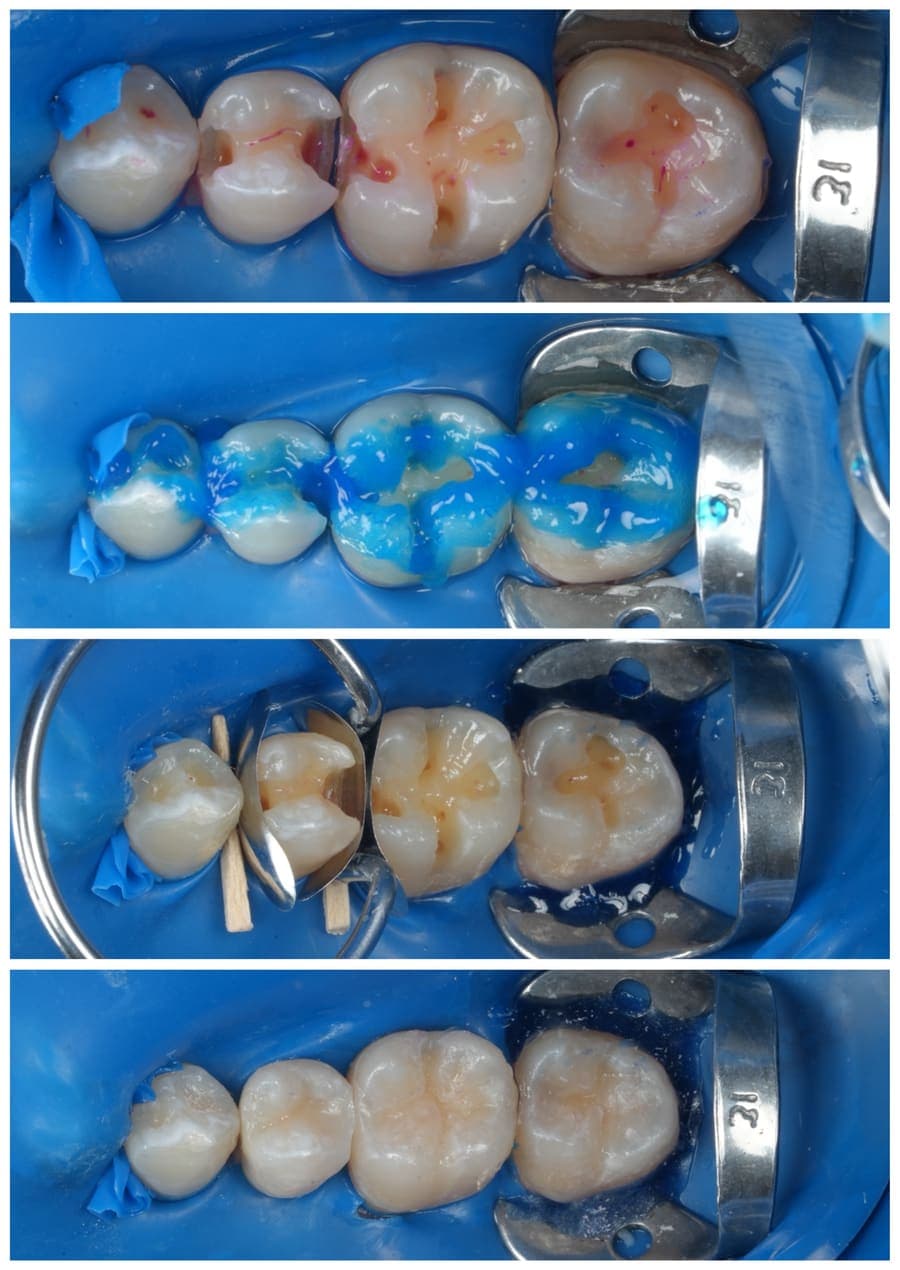
It is the branch of dentistry concerned with treating decay and repairing damaged teeth. It covers fillings, composite build-ups and the treatments that arrest decay — all with the aim of keeping the natural tooth.
Common signs are sensitivity to sweet, cold or hot, a brown or black mark on the tooth, an edge that catches your tongue, or food packing between teeth. Early decay does not hurt at all, which is exactly why regular check-ups catch it soonest.
No. Treatment is carried out under local anaesthetic and the procedure is painless. Small, shallow cavities can often be treated without anaesthetic at all.
A filling is usually completed in a single appointment, in about 30 to 60 minutes, depending on the size of the cavity and how many teeth are being treated.
Composite fillings are the colour of the tooth, bond to the tooth structure and let us rebuild the natural shape. Amalgam, used in the past, is visible, requires removing more healthy tissue, and gives no aesthetic result.
The decay advances towards the nerve. Past that point a filling is no longer enough and a root canal is needed; at an advanced stage the tooth can be lost altogether.
Yes. Heavily damaged teeth can be rebuilt in composite or, where too little structure remains, protected with a crown. Which of the two applies is decided at the consultation, after assessing the tooth.
Tell us what is troubling you and we will propose a treatment plan built around your case. We reply quickly on WhatsApp, in English.